
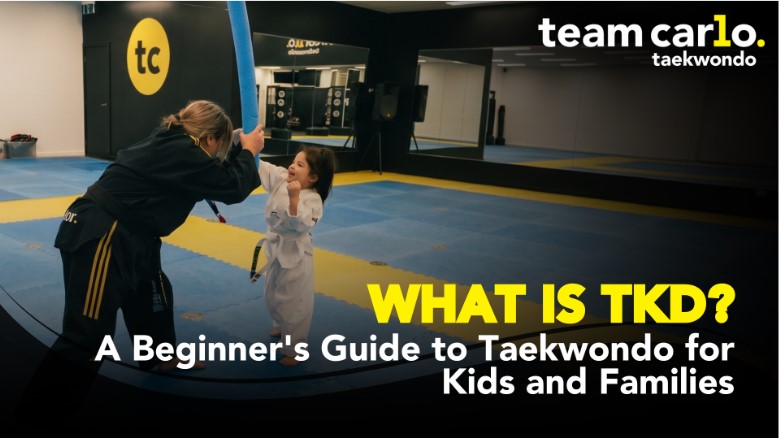
Every parent has been there — a child comes home buzzing about wanting to try karate, or ninjas, or “that kicking thing” they saw at a friend’s birthday party. And then comes the research spiral. What is the difference between karate and taekwondo? What is TKD? Is it safe for toddlers? Will it instill discipline or simply cause a perfectly placid child to kick the furniture?
These are good questions. And they deserve good answers. The “where do I even begin?” conversation is one of the most common ones the team at Team Carlo and Carlo work with Melbourne kids and families on every week. So this is a real beginner’s guide – no jargon, no assumptions, just all the things a family needs to know before taking that first step.
So What Is TKD, Exactly?
Taekwondo (TKD) is the most popular combat sport in the world and is a Korean martial art. The name itself means something. Tae means foot or kick. Kwon means fist or punch. Do means way or discipline. So taekwondo and by extension TKD literally means “foot and fist way”.
Its status as a significant athletic discipline is demonstrated by the fact that it was made an official Olympic sport at the Sydney 2000 Games and has remained a staple ever since. But the Olympic stage is only part of the story. TKD isn’t about competing on a world stage for most students, especially children. It’s about developing physical skills, mental focus and a sense of personal achievement – week by week, belt by belt.
The art is characterised by its emphasis on high , fast kicks and dynamic footwork . Unlike other martial arts, taekwondo is especially well-suited for children as the explosive movement patterns, flexibility and coordination are fundamentals that start at a young age and combine to make training this traditional Korean art really exciting.
What is TKD training composed of?
For families who have never entered a martial arts school, there is no experience to draw on which can add anxiety to trying something new, so having an idea of what a typical class looks like helps alleviate that stress.
The Warm-Up
Each session starts with a more structured warm-up. This is not a choice, it is not sensitive — this is incorporated into training. Dynamic stretches, light cardio, and movement drills get the body prepared for the technical work they`ll do next while doing this lowers the injury risk enormously. Eventually the warm-up itself works as an athletics training.
Technique and Patterns
The core of most TKD sessions involves learning and refining techniques — kicks, stances, blocks, and strikes — as well as practising poomsae (sometimes spelled poomse), which are choreographed sequences of movements performed solo. Poomsae are the grammar of taekwondo, encoding many foundational principles of the art in repeatable, trainable forms. Practicing them builds muscle memory, concentration and an underlying technical foundation.
Sparring
As students progress, controlled sparring becomes part of the picture. This is where techniques get applied in a live context — but it’s far more measured than the word “sparring” might suggest. Great taekwondo programs introduce contact slowly, with full padding and always in the context of mutual respect and safety. It has little to do with fighting and much more to do with reading an opponent, managing distance and controlling your emotions.
Cool-Down and Mindset
A professionally run class closes with a cool-down and, often, a brief moment of reflection or intention-setting. This is one of the elements that separates taekwondo from purely physical exercise — the philosophical underpinning of the discipline encourages students to think about how they carry themselves beyond the mat.
Why TKD Works So Well for Kids in Melbourne
Melbourne families have no shortage of activity options for their children. Sports are everywhere. But TKD provides what team sports and even general fitness classes rarely deliver together: individual development in a supportive group environment.
According to the National Library of Medicine, children aged 5–17 should do at least 60 minutes of moderate to vigorous physical activity daily. Taekwondo contributes meaningfully to that target — but it also builds something beyond physical fitness. The discipline and goal-setting framework embedded in the belt system gives children a clear pathway of achievement that builds genuine confidence over time.
Carlo has observed it consistently over years of teaching: the child who walks in uncertain and quiet in week one is rarely the same child who earns their first belt a few months later. The change isn’t dramatic or sudden — it accumulates through small moments of mastery, one class at a time.
The kids’ martial arts programs at Team Carlo are designed specifically around this progression model, with age-appropriate cohorts and a curriculum that keeps children challenged without pushing them into frustration.
Belt Rankings: How Progression Works
One of the first things children ask about is the belts. It’s a fair fixation — the belt system is one of the most visible and motivating aspects of taekwondo, and understanding how it works helps set realistic expectations.
Most TKD schools follow a colour-coded progression that moves from white (beginner) through a series of colours — yellow, green, blue, red — before reaching black belt at the advanced end. The number of belt levels varies between schools and governing bodies, but the principle is consistent: each belt represents a genuine increase in technical skill and knowledge.
Gradings — the formal assessments at which students demonstrate readiness for the next level — typically occur every few months. We weigh the practice of grading as an event, not a standard financial transaction. That makes the system worthwhile: students must earn each belt.
This means that the black belt is the most serious of long term goals (often taking several dedicated years of training). Your skepticism needs to be very high when a child can do it in 12-18 months according to families.
The First Step Is the Only Hard One
Starting anything new has a learning curve — for kids and parents alike. Well, taekwondo has a tendency to make that curve seem worth climbing in absolutely no time at all. In a well-managed environment children quickly find their feet, and clients frequently comment how the confidence and concentration they observe developing on the mat begins to spill over in the home and at school.
The best advice we give any Melbourne family looking to decide whether TKD is right for them is simple: go down and watch a class. Ask questions. Talk to the instructor. The answers will tell the whole story far better than any website can.
To learn more, ask a question, arrange a visit, or reach out— the team at Team Carlo is always happy to help families find the right starting point.
Frequently Asked Questions
What age can children start TKD?
Team Carlo, as such most schools except from the age of about 4-5 years old. At that age you should just be working on movement and coordination, having fun not doing technique. Structure becomes clearer as children move through the primary years, with the curriculum always changed to meet the developmental stage of each age group.
Does my child need to be fit or flexible before starting?
Not at all. Taekwondo builds fitness and flexibility — it doesn’t require them as entry conditions. Children of all body types and athletic backgrounds are welcome, and a good instructor will meet each student exactly where they are. Flexibility in particular improves significantly with consistent training, often surprising both children and their parents.
How do Melbourne families find the right TKD school?
The best approach is to visit in person and watch a class. Pay attention to how the instructor engages with students of different abilities, whether the class has clear structure, and whether the overall atmosphere feels safe and encouraging. Families who want a closer look at what a professionally run program looks like are welcome to explore the training and program options at Team Carlo as a reference point.